Bad for You?! Backed by Law: What's Actually in Your Glass
Why Italian Wine Can't Lie to You
I get asked a lot, especially by people who are careful about what they eat and drink, whether wine is "bad for you." Usually the real question underneath is about sugar and calories, and whether what's in the glass is really just grapes, or something engineered to taste a certain way. As a winemaker, that question deserves a real answer, not a marketing one.
So here it is: in Italy, I am not legally allowed to add sugar to my wine. Not a little, not a lot. It's not a stylistic choice I'm making because it sounds good on a label — it's the law.
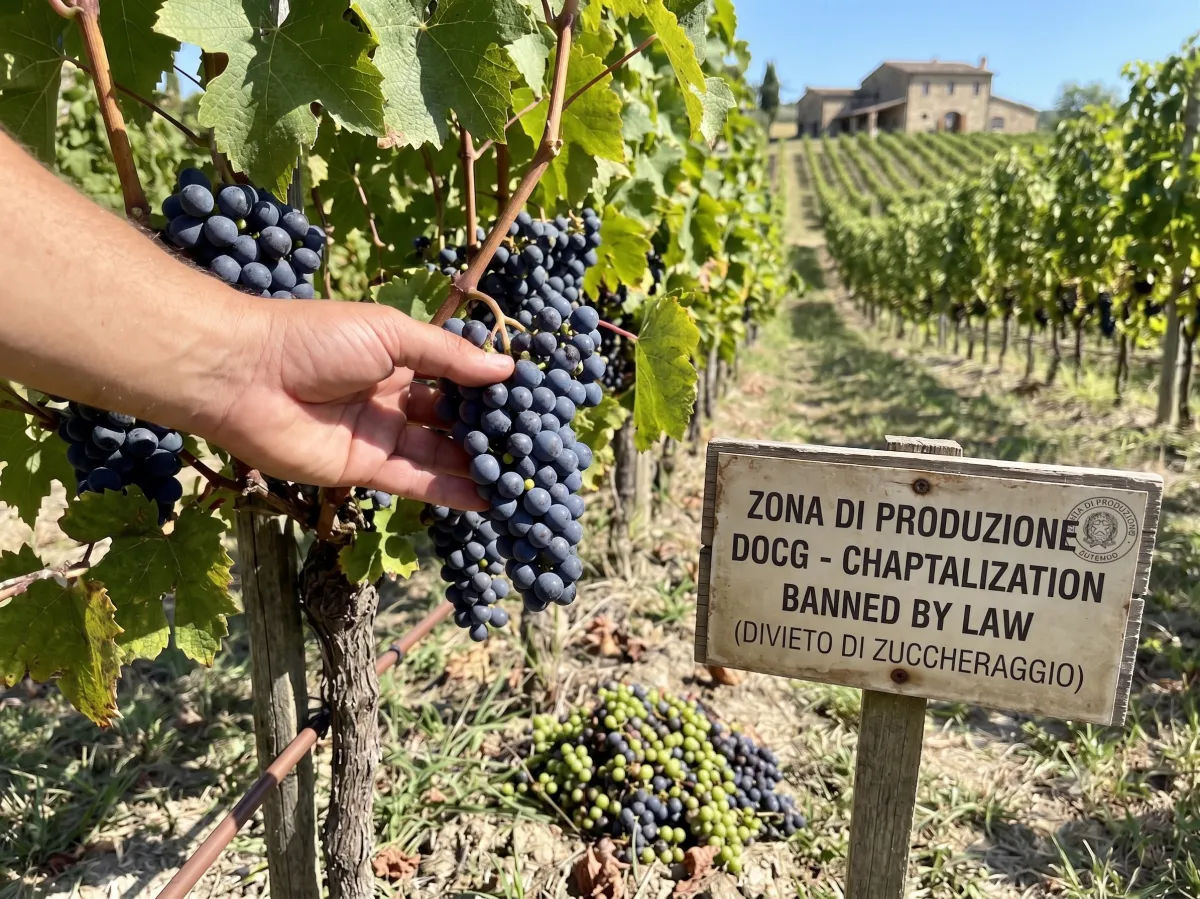
Chaptalization is banned where I work
There's a winemaking practice called chaptalization: adding sugar to the grape must before or during fermentation to boost the eventual alcohol level, usually to compensate for grapes that didn't ripen enough on their own. It's legal in parts of northern Europe, where the growing season is cooler and grapes sometimes struggle to reach full ripeness. It has never been legal in Italy, or across most of Southern Europe. Our sun does that work, not a bag of sugar.
That single rule tells you something important about what's in the bottle. If a wine tastes balanced, if it has enough natural sweetness and body to feel complete, that came from the vineyard — from where the vines are planted, how they were farmed, and when we decided to pick. It didn't come from a tank of dissolved sugar added to fix a shortfall. My job, and the job of our agronomy team, is to get that ripeness right in the field. There's no shortcut waiting for us in the cellar.
The bigger picture: fewer additives, less room to intervene
Sugar is just the most visible example. Italian appellation law — DOC and DOCG rules — is far more restrictive than what US regulations allow when it comes to what a winemaker can add or adjust. In the United States, the TTB currently permits around 75 different additives in wine production, and because wine falls under TTB rather than FDA oversight, none of it has to appear on the label. A wine can be acidified, colored, sweetened, or textured with additives, and as a consumer you'd have no way to know.
That's not a criticism of American winemakers, many of whom are working within a genuinely difficult climate and market. It's just a different legal reality. Here, the rules assume the wine should be a record of the place and the vintage — not a product tuned to hit a flavor target. When you open a bottle of real Italian wine, you're tasting a fairly narrow, tightly regulated set of decisions: which grapes, which vineyard, how it was farmed, when it was picked, how it fermented. That's it. There isn't much else legally allowed to be in there.
What this means for the calorie and sugar questions people actually ask me
Here's where I think the health-conscious wine drinker gets the most value out of understanding this. Research from the Wine Market Council found that nearly half of U.S. wine consumers believe wine is high in added sugar, and most badly overestimate its calorie count. In reality, dry wine ferments virtually all of its natural grape sugar into alcohol — that's what fermentation is. A 5-ounce glass of dry wine averages around 120 to 125 calories, according to USDA data, with roughly 4 grams of carbohydrate. There's no hidden spoonful of sugar sitting in there.
For Italian wine specifically, that picture is even cleaner, because the law closes the door on the one method a winemaker could otherwise use to sweeten or boost a wine artificially. What you're drinking is what the vineyard grew, and what our team was skilled enough to bring to full ripeness without any chemical assistance. If the vintage was hard, we don't get to paper over it with sugar. We have to actually farm well enough, every year, to get it right.
I think that's worth knowing, especially if you're someone who reads ingredient labels on everything else you consume and has just had to take wine on faith. With Italian wine, the faith is backed by law. What's in your glass is the honest result of labor in the vineyard and a lot of years of learning this land — nothing added, nothing adjusted, nothing hidden.
That's the whole point of doing this work the way we do it.
Invite us to your Party!
We'll Make it a great wine Experience!

If reading this made you think about your own gathering, even just a small dinner with friends, a birthday, a team night, or simply an excuse to bring people together, then I would genuinely love to hear from you.
There is no pressure with us. No obligation. No complicated process. Just a conversation.
We’ll talk about what you have in mind, the kind of atmosphere you want, the people you’re inviting, and we’ll build something around that. It can be as relaxed as friends sitting around a couch with pizza and wine, or as elegant as a multi-course dinner with full service. Most of the time, the best events are the ones that feel the most natural to you.
My team and I take care of everything, but more importantly, we make sure it feels like your evening, not a scripted event, not a performance, just something real, warm, and memorable.
So if you’re curious, even slightly, reach out.
We’ll be happy to chat, share ideas, and help you understand what’s possible.
And if it doesn’t feel like the right fit, that’s completely okay too. Wine should never feel forced.
But if it does come together, I can promise you one thing from my heart:
we will create something people will remember for a long time.
CLICK TO FIND OUT MORE ABOUT
OUR PRIVATE EXPERIENCES
Tonight, I’ll probably open something simple. Maybe from the south.
Something that reminds me why I started doing this in the first place.