HOW WINE IS MADE — PART 2
Analysis & Fermentation: When Grape Juice Becomes Wine
In the first part of this series, we followed the grapes from the vineyard to the cellar, starting with the harvest and continuing through destemming and crushing. At the end of that process, we have what we call mosto, the grape must: juice, skins, seeds and all the natural components that came from the grapes. It is full of sugar, acidity, aromas and potential, but it is not wine yet.
This is where one of the most fascinating parts of winemaking begins: fermentation.
For me, this is also one of the moments when the winemaker really starts to become involved. The vineyard has already given us the raw material, but now we have to understand exactly what we have in front of us. Before fermentation begins, I analyze the must, looking at sugar levels, acidity, pH, temperature and the overall condition of the juice. These numbers tell me a story about the grapes and, more importantly, help me decide how I want to guide the fermentation.
Every harvest is different. Even when I work with the same grape variety, from the same vineyard, the must can behave differently from one year to another because of weather, ripeness, vineyard conditions and the moment the grapes were harvested. This is why winemaking can never really be reduced to simply following a recipe. You need the analysis, but you also need experience.
So, What Is Fermentation?
In the simplest terms, alcoholic fermentation is the process that transforms the sugars naturally present in grape juice into alcohol and carbon dioxide.
The basic chemical reaction is:
C₆H₁₂O₆ → 2 C₂H₅OH + 2 CO₂
In other words, glucose is transformed into ethyl alcohol and carbon dioxide. It sounds simple, but what is actually happening inside the fermentation tank is much more complicated. The yeast carries out a long series of biological reactions, consuming the sugars and producing not only alcohol and CO₂, but also glycerol, acids, higher alcohols, esters and many other compounds that will eventually influence the aroma, flavor, texture and overall personality of the wine.
And this is an important point that many people don't realize: fermentation doesn't simply create alcohol. It helps create the wine's character.
When you smell a young wine and recognize notes of pear, apple, banana, flowers or other fruit characteristics, some of those aromas may come directly from the grape, but many others are influenced or created by the activity of the yeast during fermentation. These are often referred to as secondary or fermentative aromas.
So while we may think of yeast as something very simple, these microscopic organisms have an enormous influence on the wine in our glass.

The Invisible Workers
Yeasts are naturally present in the vineyard, on the grape skins and in the winery environment. As grapes mature, the sugars become increasingly available on the surface of the berries, creating an environment where different populations of microorganisms can develop.
When we crush the grapes, these microorganisms come into contact with the juice and fermentation can begin naturally. This is what we call indigenous, native or wild fermentation.
There is something very appealing about the idea of letting the natural yeasts of a vineyard do the work. In some wines, indigenous fermentation can contribute complexity and a strong sense of place. The problem is that nature is not always predictable. There are many different microorganisms present on grapes, and not all of them are beneficial for making a stable and clean wine.
Some wild microorganisms can produce excessive volatile acidity or other undesirable compounds, and sometimes they simply stop working before the fermentation is finished.
This is one of the reasons winemakers began developing and using selected yeasts. Rather than leaving the fermentation entirely to whatever microorganisms happen to be present, we can introduce a carefully selected strain of yeast that is known to perform well under specific conditions.
The most common wine yeast is Saccharomyces cerevisiae, a microorganism that is also part of the fermentation world of beer and bread. There are different strains available, each with different characteristics, and the choice of yeast can be another tool in the winemaker's hands.
I don't necessarily see the discussion as "wild is natural and therefore better" versus "selected is artificial and therefore worse." For me, the real question is much simpler: what does the wine need? Sometimes the best decision is to let the native microorganisms work, while in other situations a selected yeast gives me the reliability and control necessary to produce the wine I want.
The First Hours of Fermentation
Something interesting happens during the beginning of fermentation. The yeast initially has access to oxygen, and it uses that oxygen to grow and multiply. This is called aerobic respiration, and it allows the yeast population to increase rapidly.
But the oxygen in the must doesn't last very long.
As the yeast consumes the available oxygen and the fermentation environment changes, the microorganisms move toward anaerobic metabolism. This is when the real alcoholic fermentation begins, with the sugars being transformed primarily into alcohol and carbon dioxide.
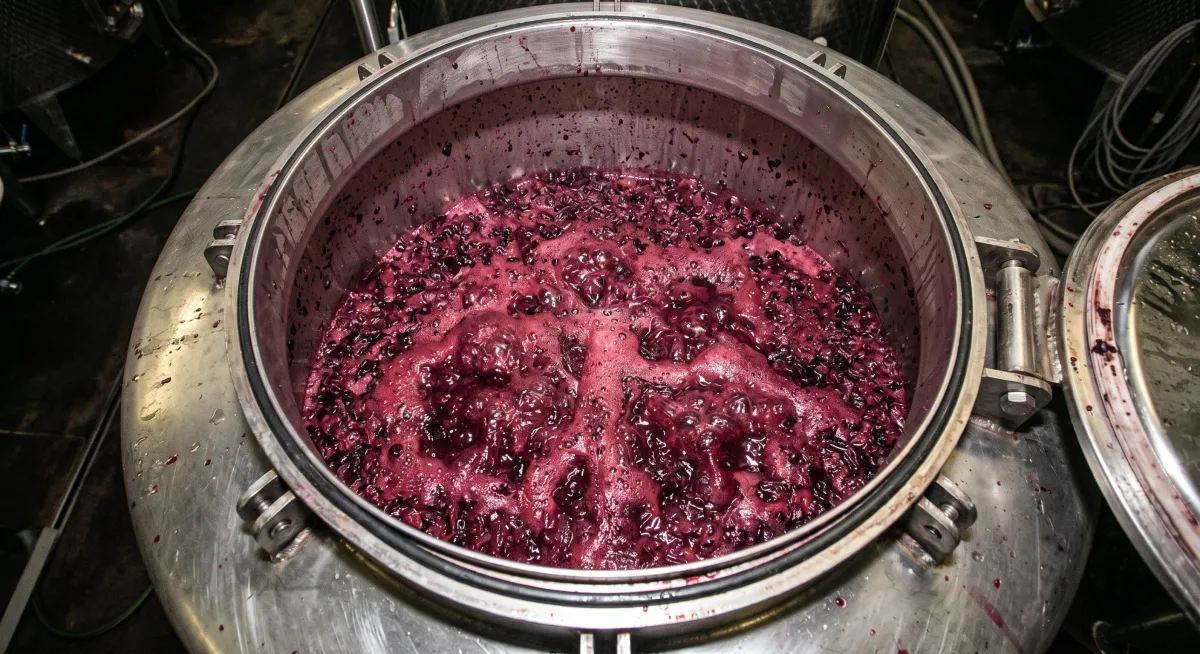
If you've ever seen a fermentation tank in action, you know exactly what I mean. The must becomes alive. Carbon dioxide rises through the liquid, the surface moves, the temperature increases and the aromas change almost from one day to the next.
This is why I always say that a fermentation tank is never really "just sitting there." There is an enormous amount of activity happening inside it, even though most of it is invisible to our eyes.
Temperature: One of the Most Important Tools
As the yeast works, fermentation produces heat. This means that temperature can increase naturally, and controlling that temperature becomes one of the most important jobs in the cellar.
If fermentation becomes too cold, the yeast can slow down dramatically or fail to start properly. If it becomes too hot, fermentation can become excessively fast, aromas can be lost and the yeast can become stressed or even die, potentially causing the fermentation to stop.
This is why we don't simply choose a temperature and forget about it. We monitor the tank continuously and make adjustments when necessary.
With white wines, we normally ferment at cooler temperatures, generally around 16–20°C (60–68°F). The reason is simple: we want to preserve the delicate aromas and freshness that are so important in white wine. Stainless-steel tanks with cooling systems allow us to keep the temperature under control throughout fermentation.
Red wine is a different story because fermentation is also part of the extraction process. When we ferment red grapes with their skins, we are trying to extract color, tannins and other phenolic compounds from those skins. For that reason, red wine fermentation is normally warmer, often in the range of 25–30°C (77–86°F).
But warmer doesn't automatically mean better. The goal is always balance. Too little extraction can produce a wine that feels thin and lacks structure, while excessive extraction can create a wine that is harsh, overly tannic or dominated by unwanted characteristics.
White Wine and the Search for Freshness
When making most white wines, we separate the juice from the skins relatively quickly after crushing. We clarify the must and then begin fermentation, with the main goal being to preserve the freshness and aromatic complexity of the grape.
This is particularly important with aromatic varieties. The beautiful floral, citrus and fruit aromas we associate with many white wines can be delicate, and excessive temperature can cause some of those aromas to disappear.
This is why temperature control is so important.
Some white wines are fermented entirely in stainless steel, while others may be fermented in small oak barrels. The choice depends on the grape, the vintage and, most importantly, the style of wine we are trying to create.
When a white wine is fermented or aged on its lees, we can also use a technique called bâtonnage, where the fine lees are periodically stirred back into suspension. As the yeast cells gradually break down through a process called autolysis, they release compounds that can contribute to a richer texture and greater roundness.
This is one of the reasons two wines made from exactly the same grape can taste completely different. The grape is only part of the story. How we ferment and treat that grape afterward can dramatically change the final wine.
Red Wine and the Extraction of Character
With red wine, fermentation becomes even more interesting because we are not only transforming sugar into alcohol; we are simultaneously extracting important components from the skins.
When red grapes are fermenting, the carbon dioxide produced by the yeast pushes the skins toward the surface of the tank, creating what we call the cap. The winemaker has to manage this cap so that the juice remains in contact with the skins.
Depending on the wine, we can use different techniques, including pump-overs and punch-downs, to keep the skins wet and encourage extraction.
The temperature and duration of this contact are extremely important. A light, fresh red intended to be enjoyed young does not necessarily need the same extraction as a powerful wine intended to spend years aging in oak.
This is one of the areas where experience really matters. You don't want to extract everything simply because you can. You want to extract what the wine needs.
The objective is not to make the biggest wine possible. The objective is to make a balanced wine.
How Do I Know When Fermentation Is Finished?
One of the most useful measurements during fermentation is density.
Before fermentation, grape must is relatively dense because of all the dissolved sugar. As the yeast consumes that sugar and converts it into alcohol and carbon dioxide, the density decreases.
Using a hydrometer or mostimeter, we can follow this change day after day. The numbers give us a very clear picture of how quickly the fermentation is progressing and whether the yeast is continuing to consume the available sugars.
When the fermentable sugars have been consumed and the density stabilizes at the appropriate level, alcoholic fermentation is essentially complete.
At that moment, something important has happened: we no longer have grape juice.
We have wine.
But that doesn't mean the winemaker gets to go home.
Not yet.
Svinatura: Separating the Young Wine
Once fermentation reaches the desired point, we eventually come to svinatura, the moment when the young wine is separated from the skins, seeds and heavier solids.
The timing of this operation depends greatly on the wine we want to make.
A young red intended for immediate enjoyment may be separated from the skins relatively early. A more structured red, particularly one intended for aging, may remain in contact with the skins longer to develop additional color, tannin and structure.
This is another decision that cannot be based on a single number.
I look at the wine, taste it, smell it and evaluate the extraction. Sometimes the analysis tells you one thing, but tasting the wine tells you something even more important.
The winemaker has to know when to say, "That's enough."
Once the wine is separated, it can continue through the next stages of its life. It may undergo clarification, stabilization, malolactic fermentation and eventually aging in stainless steel, concrete, oak or bottle, depending on the style we are trying to achieve.
And this is another important point: alcoholic fermentation is only the beginning.
What Comes After Alcoholic Fermentation?
For many red wines, and for some white wines as well, another transformation can follow: malolactic fermentation.
This is not the same process as alcoholic fermentation. Instead of yeast converting sugar into alcohol, certain bacteria convert malic acid into lactic acid.
Malic acid has a sharper, more pronounced acidity, while lactic acid is softer and rounder. The result can be a wine that feels smoother and creamier on the palate.
Sparkling wines have another fascinating chapter of their own, because a second fermentation—depending on the production method—can be used to create the characteristic carbon dioxide and bubbles.
But we'll leave that story for another part of the series.
From Analysis to Instinct
When people ask me what makes a good winemaker, they sometimes expect an answer involving knowledge of grapes, barrels or fermentation techniques.
Of course, all of that matters.
But I think a good winemaker also has to learn how to observe and listen.
The analysis tells me the sugar level, pH, acidity and density. The instruments tell me the temperature. The laboratory gives me numbers. But when I walk into the cellar, I also smell the fermentation, look at the movement of the tank and taste the wine.
You learn to recognize when something is moving in the right direction and when the wine is asking for attention.
That is what makes fermentation so fascinating to me.
It is a moment when science and nature are working together. The grapes arrive at the winery with all their potential, and then these microscopic organisms begin transforming that potential into something completely different.
Slowly, over several days, the sweetness of the grape juice disappears, alcohol develops, aromas evolve, color and structure are extracted, and what started as a bunch of grapes becomes something we can finally call wine.
And yet, even when fermentation is finished, the wine is still young.
The next chapter is about learning how to let that young wine develop, settle and mature—and that is where aging and refinement begin.
Continue the Journey Through Italy

If this article has you curious to taste how fermentation, grape variety, terroir and winemaking choices can create completely different expressions of Italian wine, I invite you to explore The Above Wines Project – Authentic Italian Wine Case. This 12-bottle selection is essentially a Grand Tour of Italy in a box, taking you from Puglia and Calabria to Campania, Tuscany, Piemonte, Veneto and Abruzzo, with sparkling wines, whites, rosé and some truly memorable reds. Each bottle comes from the small family wineries we work with and represents a different piece of the Italian wine story. It’s not simply a case of wine—it’s an opportunity to taste the diversity of Italy, one bottle at a time.
Try the Wine, 24hr Shipping:
6 Pack Discover Calabria Bundle
Invite us to your Party!
We'll Make it a great wine Experience!

If reading this made you think about your own gathering, even just a small dinner with friends, a birthday, a team night, or simply an excuse to bring people together, then I would genuinely love to hear from you.
There is no pressure with us. No obligation. No complicated process. Just a conversation.
We’ll talk about what you have in mind, the kind of atmosphere you want, the people you’re inviting, and we’ll build something around that. It can be as relaxed as friends sitting around a couch with pizza and wine, or as elegant as a multi-course dinner with full service. Most of the time, the best events are the ones that feel the most natural to you.
My team and I take care of everything, but more importantly, we make sure it feels like your evening, not a scripted event, not a performance, just something real, warm, and memorable.
So if you’re curious, even slightly, reach out.
We’ll be happy to chat, share ideas, and help you understand what’s possible.
And if it doesn’t feel like the right fit, that’s completely okay too. Wine should never feel forced.
But if it does come together, I can promise you one thing from my heart:
we will create something people will remember for a long time.
CLICK TO FIND OUT MORE ABOUT
OUR PRIVATE EXPERIENCES
Tonight, I’ll probably open something simple. Maybe from the south.
Something that reminds me why I started doing this in the first place.