HOW WINE IS MADE — PART 3
Stabilization, Sulphites & Bottling: Protecting the Wine Until It Reaches Your Glass
If you have followed me through the first two parts of this series, we have already taken quite a journey together. We started in the vineyard with the harvest, followed the grapes through crushing and destemming, looked at how we analyze the must, and then entered the fascinating world of fermentation, where yeast transforms grape juice into wine.
But fermentation is not the end of the story.
Once fermentation is finished and the wine has completed its maturation, there is still one very important responsibility for the winemaker: making sure that the wine we put into the bottle remains the wine we created in the cellar.
This is where stabilization, sulphites, and finally bottling become so important.
And there is something I want to make clear from the beginning, because I think it is one of the most important concepts in modern winemaking: stabilizing a wine does not mean changing the wine. It means protecting it.
As a winemaker, my objective is not to make every wine taste perfect according to some generic idea of what wine should be. My objective is to preserve what the vineyard has given me. The grape variety, the soil, the climate, the exposure of the vineyard, the vintage and the health of the grapes all contribute to the personality of a wine. These are the things we call, in different ways, the expression of terroir.
The cellar should help that expression come forward, not cover it up.
So, when we talk about stabilization, we are really talking about protecting the identity of the wine.
Why Does Wine Need to Be Stabilized?
Wine may look finished when fermentation is over, but chemically it is still a very complex and dynamic product. There are compounds, proteins, minerals, microorganisms and other elements that can continue to interact with each other long after fermentation has finished.
Some of these changes are completely natural and harmless. Others, however, can create problems once the wine has been bottled.
Imagine a wine leaving the winery perfectly clear and bright, only to develop a haze, crystals, an unwanted aroma or even a refermentation several weeks or months later. From the winemaker's perspective, this is something we want to prevent before the bottle leaves our control.
This is why we talk about wine stability.
There are several different types of stability, but we can think about four main areas: tartaric stability, protein stability, oxidative stability and microbiological stability. Each one addresses a different potential problem, and together they help us make sure that the wine remains healthy and faithful to its original character.
Tartaric Stability: Those Little Crystals in Your Wine
Let's start with something you may have actually seen in a bottle before.
Have you ever poured a white wine and noticed tiny, transparent crystals at the bottom of the bottle or around the cork? Sometimes people see them and immediately think that something is wrong with the wine.
In reality, those little crystals are usually potassium bitartrate, a natural compound formed from substances that are already present in grapes.
Grapes naturally contain tartaric acid and potassium. While these substances are separated within the grape, once we crush the grapes and release their juice, they come into contact with each other. During the life of the wine, they can eventually combine and form potassium bitartrate crystals.
The important thing to understand is that these crystals are harmless and do not mean that the wine is spoiled or defective. They do not have a negative effect on the taste or safety of the wine.
The problem is primarily visual.
A consumer opening a bottle of white wine and seeing crystals floating in the bottom may understandably think that the wine has something wrong with it. And because white wines are usually very clear and bright, these crystals can be particularly noticeable.
This is why we perform tartaric stabilization before bottling. One of the traditional methods is to lower the temperature of the wine, because the solubility of these salts decreases as the temperature drops. The wine is cooled sufficiently to encourage the crystals to form while the wine is still in the tank, and then those crystals can be removed through appropriate cellar practices such as filtration.
There are also other methods and stabilizing agents that can help prevent the formation of these crystals.
But the philosophy remains the same: we are not trying to change the wine's flavor or personality; we are simply trying to prevent something from happening later inside the bottle.
Protein Stability: Keeping the Wine Bright and Clear
Another area we have to consider, particularly with white and rosé wines, is protein stability.
Wine naturally contains proteins, and under certain conditions some of these proteins can become unstable and create a cloudy appearance. Again, this does not necessarily mean that the wine is bad. It simply means that something has changed in the wine that the consumer was not expecting to see.
This is one of those situations where winemaking requires balance.
There are treatments available to help stabilize proteins before bottling, but a good winemaker doesn't simply treat every wine in exactly the same way. We first need to understand the wine, analyze it, and determine what it actually needs.
This is an important principle in my own approach to winemaking: if the wine does not need an intervention, I don't want to make one simply because it is part of a standard recipe.
Every vineyard is different, every vintage is different, and every wine has its own chemistry. The best winemaking is often about knowing when to intervene and, just as importantly, when to leave the wine alone.
Oxygen: Friend and Enemy
Then we have oxygen, which is perhaps one of the most fascinating parts of winemaking.
Oxygen is not necessarily bad for wine. In fact, during certain stages of winemaking, controlled exposure to oxygen can be useful and can contribute to the development of a wine.
The problem comes when oxygen is present in the wrong amount or at the wrong moment.
Think about an apple. When you cut it open, the inside is fresh and bright. Leave it exposed to air for a while and it gradually begins to turn brown. Wine can also undergo oxidative changes, although the chemistry is much more complex.
Too much oxygen can cause wine to lose some of its freshness and aromatic intensity and can eventually alter its color and overall character.
This is particularly important with delicate white wines, rosés and aromatic varieties, where freshness is a fundamental part of their identity.
During transfers, filtration, storage and especially bottling, the winemaker therefore pays very close attention to oxygen exposure. The objective is not to eliminate oxygen from the winemaking process completely, but rather to control it and give the wine exactly what it needs.
Once again, it comes back to balance.
And Then There Are Sulphites
Now we arrive at one of the subjects that probably creates the most confusion among wine consumers: sulphites.
You have probably seen the words "Contains Sulphites" on a wine label and wondered exactly what that means.
Sulphur dioxide, commonly referred to as SO₂, has been used in winemaking for a very long time because it is an extremely effective tool for protecting wine. It can help control oxidation and also plays an important role in managing undesirable microorganisms.
But I want to make one distinction very clear:
Sulphites do not make the wine.
The wine comes from the grapes, the vineyard, the fermentation, the decisions made by the winemaker and ultimately the character of the terroir. Sulphur dioxide is simply one of the tools we can use to protect all that work.
For me, the question should never be, "How much sulphite can I add?"
The better question is, "How little do I need to use while still protecting the wine?"
That is a very different philosophy.
Using too little protection can leave a wine vulnerable to oxidation or microbial problems. Using more than necessary is also not the goal, because we want the wine to maintain its natural aromatic and sensory character.
This is why analysis and experience are so important. We need to understand the wine's pH, its condition, its oxygen exposure, its microbiological stability and many other factors before deciding how much protection it needs.
In simple terms, I like to think of it this way:
As little as necessary, but as much as needed.
That is the balance a winemaker is constantly trying to find.
And this is also why the phrase "natural wine" can sometimes create confusion. Good winemaking, regardless of philosophy, requires understanding chemistry and biology. The goal should always be to respect the wine and the vineyard while making responsible decisions that allow the wine to remain healthy and enjoyable.

Stabilization Is Not About Making Every Wine the Same
This is perhaps the most important message I want to leave you with in this article.
When people hear about filtration, stabilization, sulphites or other cellar practices, they sometimes imagine that the winemaker is manipulating the wine until it becomes an industrial product.
That can certainly happen when techniques are used without consideration for the individual wine, but that is not what good winemaking should be about.
For me, stabilization is about preservation rather than transformation.
If a vineyard gives me a wine with beautiful acidity, I want that acidity to remain. If the grape variety has beautiful floral aromas, citrus, tropical fruit, herbs, spices or minerality, I want those characteristics to survive the winemaking process. If the vintage has a particular personality because of the weather conditions during the growing season, I want that personality to remain in the bottle.
The wine should still tell me where it came from.
That is why I believe the winemaker's job is partly knowing when to intervene and when not to intervene.
Sometimes the best decision is to do something.
Sometimes the best decision is to leave the wine alone.
The art is knowing the difference.
Finally, We Reach the Bottle
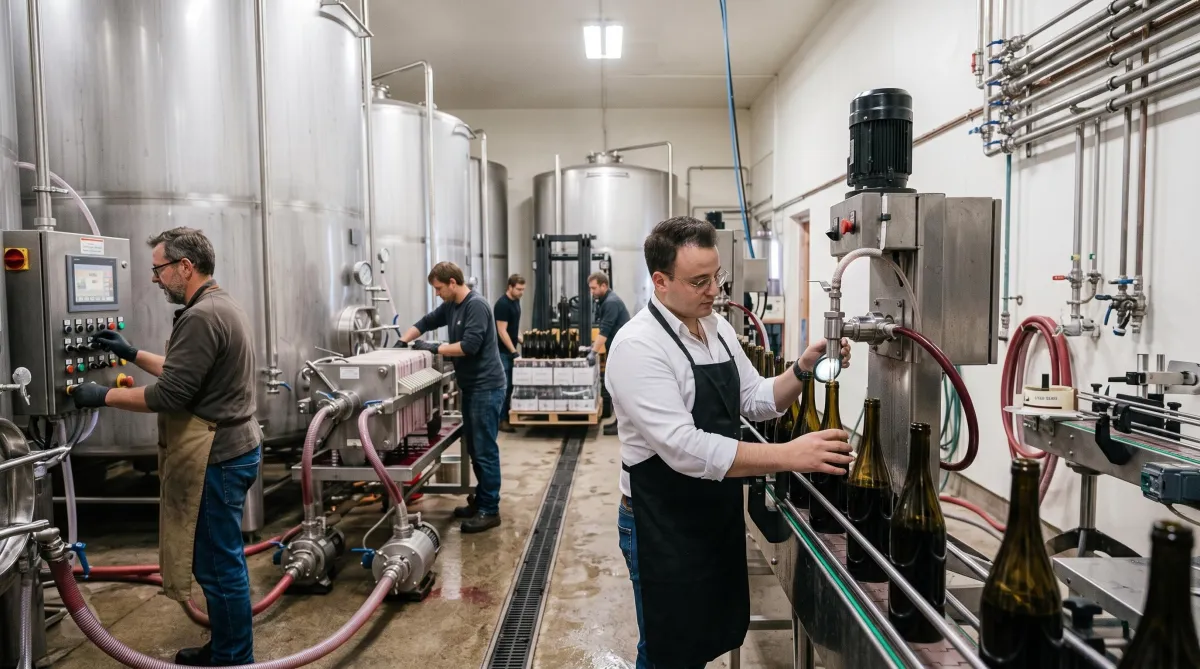
After fermentation, maturation, analysis and stabilization, we eventually reach the moment that every winemaker looks forward to: bottling.
It may seem like a simple operation, but it is actually another delicate moment in the life of a wine.
The wine needs to be protected from unnecessary oxygen exposure, the equipment and bottles need to be properly prepared, the wine needs to be at the appropriate level of stability, and the closure needs to provide the right protection for the style of wine and its expected life.
Then, finally, the wine enters the bottle.
At that point, something quite remarkable happens.
A process that began months earlier, sometimes much earlier in the vineyard, is now enclosed inside a glass bottle.
But the wine's journey is not finished.
It may travel hundreds or thousands of miles. It may sit in a warehouse, on a restaurant shelf, in a wine shop or in someone's cellar. It might be opened tomorrow, or perhaps several years from now.
And when someone finally pulls the cork or opens the bottle and pours the wine into a glass, we want that person to experience the same identity that we saw when we were working with the wine in the cellar.
That is why stabilization matters.
Not because we want to make the wine different.
Because we want to make sure it remains itself.
From the Vineyard to Your Glass
And with that, we have reached the end of our three-part journey through how wine is made.
We began with the harvest, when the winemaker makes one of the first and most important decisions: deciding when the grapes are ready to leave the vineyard.
We then followed the grapes through crushing, destemming, analysis and fermentation, where the work of yeast transformed grape juice into wine.
Finally, we arrived at stabilization and bottling, where the winemaker's role changes from creating the wine to protecting what has already been created.
For me, this is the real philosophy behind winemaking.
We should use science, technology and experience when they are necessary, but we should never forget where the wine begins.
It begins in the vineyard.
The soil, the climate, the grape variety, the health of the vines and the particular character of each vintage give us the raw material and the personality of the wine. Our responsibility in the cellar is to guide that wine, not to erase it.
A great winemaker should therefore not try to make the vineyard disappear behind technique.
Instead, we should make sure that when the bottle is finally opened, the vineyard can still speak.
And when you raise that glass, I hope you can taste more than just wine. I hope you can taste the grape, the soil, the climate, the vintage, the work of the people who made it and, ultimately, a little piece of the place where it was born.
Because that, for me, is what wine is all about.
Salute!
Continue the Journey Through Italy

If this article has you curious to taste how fermentation, grape variety, terroir and winemaking choices can create completely different expressions of Italian wine, I invite you to explore The Above Wines Project – Authentic Italian Wine Case. This 12-bottle selection is essentially a Grand Tour of Italy in a box, taking you from Puglia and Calabria to Campania, Tuscany, Piemonte, Veneto and Abruzzo, with sparkling wines, whites, rosé and some truly memorable reds. Each bottle comes from the small family wineries we work with and represents a different piece of the Italian wine story. It’s not simply a case of wine—it’s an opportunity to taste the diversity of Italy, one bottle at a time.
Try the Wine, 24hr Shipping:
6 Pack Discover Calabria Bundle
Invite us to your Party!
We'll Make it a great wine Experience!

If reading this made you think about your own gathering, even just a small dinner with friends, a birthday, a team night, or simply an excuse to bring people together, then I would genuinely love to hear from you.
There is no pressure with us. No obligation. No complicated process. Just a conversation.
We’ll talk about what you have in mind, the kind of atmosphere you want, the people you’re inviting, and we’ll build something around that. It can be as relaxed as friends sitting around a couch with pizza and wine, or as elegant as a multi-course dinner with full service. Most of the time, the best events are the ones that feel the most natural to you.
My team and I take care of everything, but more importantly, we make sure it feels like your evening, not a scripted event, not a performance, just something real, warm, and memorable.
So if you’re curious, even slightly, reach out.
We’ll be happy to chat, share ideas, and help you understand what’s possible.
And if it doesn’t feel like the right fit, that’s completely okay too. Wine should never feel forced.
But if it does come together, I can promise you one thing from my heart:
we will create something people will remember for a long time.
CLICK TO FIND OUT MORE ABOUT
OUR PRIVATE EXPERIENCES
Tonight, I’ll probably open something simple. Maybe from the south.
Something that reminds me why I started doing this in the first place.