Organic Wine, Sulfites & Natural Wine: What Does the Label Really Tell You?
The Winemaker’s Perspective: Organic Wine, Sulfites & the Search for Authenticity
There is a question I hear more and more often:
Is organic wine healthier? What does “no added sulfites” actually mean? And if a wine is organic, does that automatically mean it is a better or more natural wine?
As an Italian winemaker, and as someone who studied enology, viticulture and the chemistry behind winemaking, I think this conversation deserves a little more nuance.
Because wine is not simply a matter of putting grapes into a bottle.
Wine is the result of thousands of chemical and biological reactions taking place between the vineyard, the grape, microorganisms, oxygen, temperature, time and, ultimately, the decisions made by the winemaker.
And sometimes, the simplest-looking label can hide a much more complicated story.
First: Organic does not automatically mean better wine
Let me start with something that may surprise some people.
I am absolutely in favor of reducing unnecessary inputs in the vineyard and winery.
As a winemaker, I want to make a good wine with as few additions and interventions as reasonably possible.
But there is an important distinction between reducing unnecessary intervention and refusing every tool available to the winemaker.
Nature is beautiful.
Nature is also extremely difficult to control.
A vineyard is a living ecosystem. Every year we have to deal with rain, humidity, heat, drought, insects, fungi, diseases, soil conditions and countless microorganisms.
A grapevine does have its own defense mechanisms. The plant produces compounds to protect itself. The vineyard also has beneficial insects, microorganisms and natural biological competition.
The job of a good viticulturist is to understand all of this.
The goal should be to prevent problems before they become problems.
Good vineyard management, canopy management, soil management, ventilation around the fruit, monitoring of weather conditions and understanding the biology of potential diseases can dramatically reduce the need for interventions.
This is where I believe the knowledge of the vineyard is more important than the marketing language on the bottle.
A great winemaker doesn't simply follow a label or a philosophy.
A great winemaker understands why a particular intervention may or may not be necessary.
Organic grapes are not the same thing as organic wine
This distinction is especially important when we are talking about wines coming from different countries.
In the United States, there is a significant difference between a wine labeled “Organic” and one labeled “Made with Organic Grapes.”
Under USDA organic rules, wine labeled as organic cannot contain added sulfites. Wines labeled “Made with Organic Grapes” can contain added sulfites within the applicable limits. The USDA specifically states that wine with added sulfites cannot be sold in the U.S. under the “Organic” wine category.
This is one reason imported wines can become confusing.
European organic wine regulations are not identical to the U.S. system. In the European Union, organic wine can use sulfur dioxide under defined conditions and limits. For example, current EU rules establish maximum sulfur dioxide levels for organic wines, including 100 mg/L for certain red wines and 150 mg/L for certain white and rosé wines with less than 2 g/L residual sugar.
So when someone tells me:
“This is an organic European wine, therefore it contains no sulfites.”
That statement is simply not necessarily true.
And this brings us to one of the biggest misunderstandings in wine.
Sulfites are not the enemy
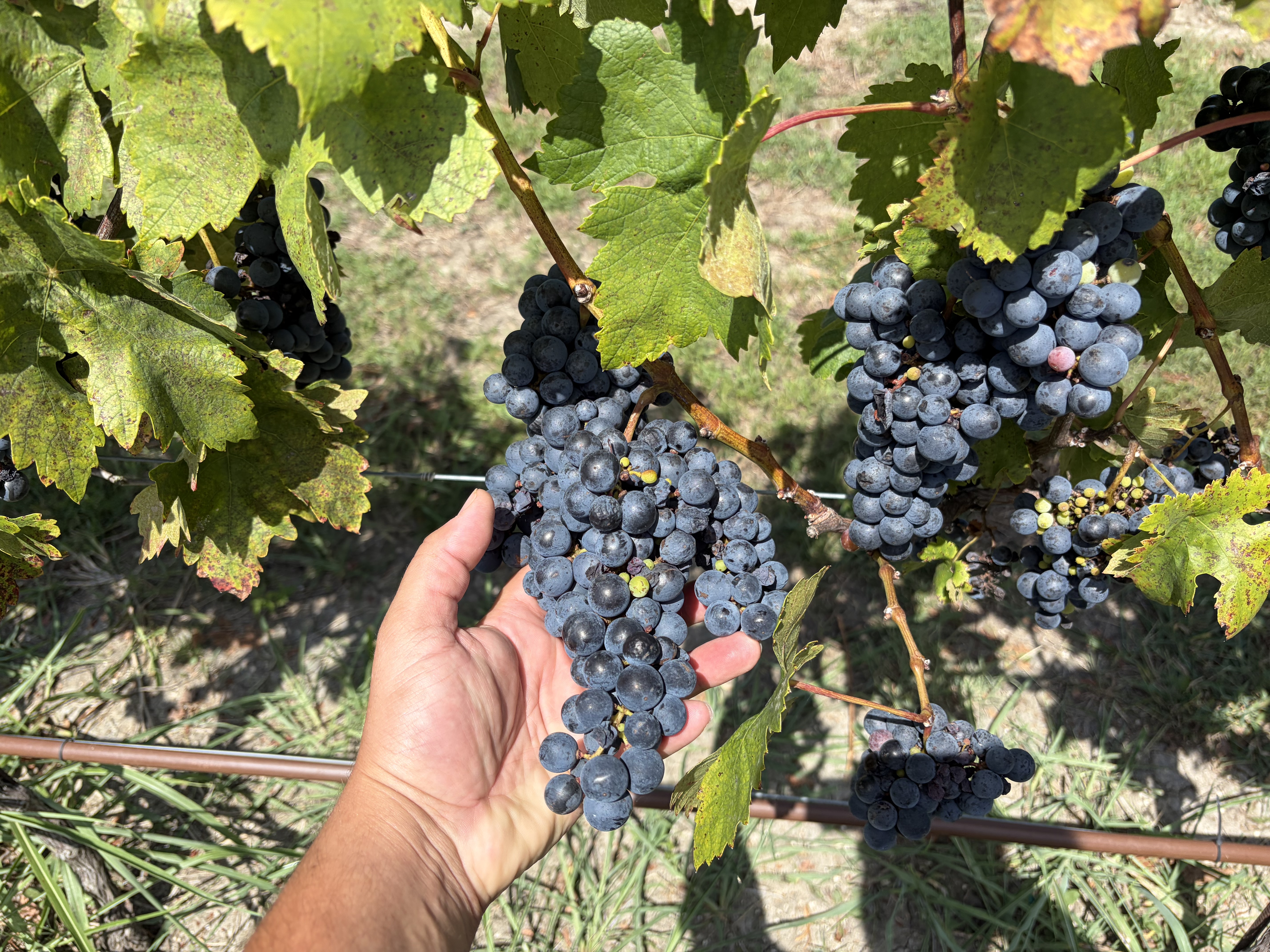
Sulfites occur naturally in wine.
During fermentation, yeast can produce sulfur dioxide and other sulfur compounds as part of its metabolism.
So there is an important difference between:
No added sulfites and No sulfites.
The second statement is essentially impossible for a normally fermented wine to guarantee.
You can produce a wine with no sulfites intentionally added, but that does not mean the finished wine contains zero sulfites.
This is why I prefer to talk about added sulfites rather than “sulfite-free wine.”
And sulfites are not some artificial substance invented by modern wineries to make wine unhealthy.
Sulfur dioxide is a naturally occurring chemical compound and has been used in winemaking for a very long time.
So why do winemakers use sulfur dioxide?
Because oxygen is a problem. Not always immediately. But eventually.
Think about what happens when you cut an apple and leave it on the kitchen counter.
The flesh begins to turn brown. That is oxidation.
Wine is not an apple, obviously, but the chemistry of oxidation is fundamental to understanding why we protect wine from oxygen.
Oxygen can react with compounds responsible for wine's color, aromas and freshness.
In white wines, oxidation can lead to the loss of delicate fruity and floral aromas and eventually create undesirable oxidized characteristics.
In red wines, oxidation can contribute to color changes and the loss of fresh fruit character.
The wine continues to evolve after fermentation, and oxygen exposure is one of the major forces controlling that evolution.
This is where sulfur dioxide becomes an extremely useful tool.
It can act as an antioxidant and, importantly, as an antimicrobial agent.
In practical winemaking, sulfur dioxide helps protect the wine from the uncontrolled consequences of oxygen and certain microorganisms.
That doesn't mean more sulfites = better wine.
Quite the opposite. The philosophy I follow is: Use what is necessary. Don't use what isn't necessary. The objective is not to make a wine loaded with sulfites. The objective is to protect the wine with the minimum effective intervention.
But isn't oxidation natural?
Yes. And this is an important distinction. Natural does not automatically mean desirable. Wine is constantly changing. Some evolution is part of what makes wine fascinating. Controlled aging can create complexity, texture and new aromas.
But uncontrolled oxidation is different. A winemaker has to decide where the line is between evolution and deterioration.
If I allow a wine to oxidize excessively simply because I want to say that I made it without intervention, I haven't necessarily made a more authentic wine.
I may simply have made a damaged wine. And this is where my scientific background becomes particularly important. When I analyze a wine, I don't just ask:
“Is it organic?” I want to know:
What is the pH? What is the total acidity? What is the alcohol? What is the residual sugar? What is the volatile acidity? What is the sulfur dioxide level? How stable is the wine? How did the fermentation behave? What microorganisms were involved? What happened to the aromas? What happened to the color?
And most importantly:
Does the wine still taste like the grape and the place where it was grown?
The real goal: preserve the identity of the grape
This is where I sometimes disagree with the way the organic-versus-conventional conversation is presented.
For me, the ultimate purpose of wine is not simply to be “organic.”
Wine should tell you something.
It should tell you about a grape.
It should tell you about a vineyard.
It should tell you about a climate, a soil, a tradition and a year.
In Italy we have hundreds of native grape varieties, many of which can express completely different personalities depending on where they are grown.
That diversity is one of the things I love most about Italian wine.
If excessive oxidation, uncontrolled microbial activity or other faults completely cover the original aromas of the grape, then we lose something extremely important.
We lose territorial identity.
A Fiano from Campania should not smell and taste like every other white wine.
A Nebbiolo from Piemonte should not lose its identity.
A Falanghina from volcanic Campania should have the opportunity to express the characteristics that make Falanghina from that environment interesting.
That, to me, is authentic winemaking.
Organic is about the process. Quality is about the winemaker.
This is probably the most important point I want people to take away from this article.
Organic certification is valuable. But organic certification is not a quality certification.
It tells you that the producer has followed a defined set of rules.
That is important.
It tells you something about agricultural practices and permitted inputs.
But it does not tell you that the wine will necessarily be balanced, expressive, stable or delicious.
The same is true in the opposite direction.
A conventionally certified wine is not automatically a bad wine.
And an organic wine is not automatically a great wine.
The bottle still depends on the vineyard, the vintage, the fruit quality, the technical decisions and the people making it.
There are extraordinary organic producers.
There are extraordinary conventional producers.
There are excellent low-intervention producers.
And there are poorly made wines in every category.
That is why I don't believe the conversation should be:
Organic vs. conventional.
I think the better question is:
What did the winemaker actually do, and why?
What about “natural wine”?
Natural wine is another term that needs some clarification.
Unlike the USDA organic category, “natural wine” does not have one universal legal definition that tells consumers exactly what is inside the bottle.
Generally, the term refers to wines made with minimal intervention, often from organically or biodynamically farmed grapes, with little or no manipulation in the cellar and often little or no added sulfur dioxide.
There are some beautiful natural wines.
I love the philosophy of allowing the vineyard and vintage to speak.
But again, minimal intervention does not mean zero chemistry.
Fermentation itself is chemistry.
Malolactic fermentation is chemistry.
Oxidation is chemistry.
Yeast metabolism is chemistry.
Acid-base reactions are chemistry.
Wine is chemistry happening inside a biological system.
As a winemaker who studied these processes, I don't see chemistry as the enemy of natural wine.
Chemistry is what wine is.
The question is whether we understand those reactions well enough to guide them.
“Natural” should not mean “uncontrolled”
This is perhaps where my Italian winemaker side becomes very opinionated.
I want a wine to feel alive.
I want it to have personality.
I don't want every wine to taste technically identical.
But I also want the wine to be healthy, stable and representative of its grapes.
If a wine develops excessive volatile acidity, severe oxidation, unwanted microbial aromas or other faults, I don't believe those characteristics automatically become “terroir” simply because the winemaker didn't intervene.
Sometimes a fault is just a fault. And recognizing that requires understanding what is happening chemically and microbiologically in the wine.
So should you buy organic wine? My philosophy as a winemaker
Yes—if supporting organic agriculture is important to you. But don't stop there. Ask questions: Who made the wine? Where were the grapes grown? How was the vineyard managed? What does the producer believe about intervention? Was sulfur dioxide added, and if so, how much? Was the wine filtered? What kind of fermentation was used? How was the wine protected from oxygen? Most importantly, does the wine taste good? Does it have freshness? Does it have balance? Does it have varietal character? Does it tell you something about where it came from?
Those questions tell me much more about the quality of a wine than a single word printed on the front label. Personally, I don't want to make wine that tastes like a laboratory, but I also don't want to make wine that tastes like an uncontrolled experiment. I want to make wine that tastes like grapes from a place.
That means respecting the vineyard, understanding the microorganisms, understanding fermentation, understanding oxygen, understanding sulfur dioxide, and knowing when to intervene—and, perhaps even more importantly, knowing when not to intervene. The best winemaking, in my opinion, is not about adding everything you can, and it is not about refusing everything you can add. It is about knowing what the wine needs.
Because at the end of the day, my job is not to make an “organic wine,” a “natural wine,” or a “conventional wine.” My job is to make the best possible wine while preserving the identity of the grape, the vineyard and the territory that gave it life. And when you finally pour that wine into a glass, I want you to taste exactly that.
FOR MORE INFOS ON SULFITES AND IT"S PRESENCE IN FOODS AND NOT ONLY WINES, READ MY PREVIOUS ARTICLE: CLICK HERE
Meet the Italian Owner of Baroni Capoano from Calabria!
An Evening of Wine, Food & Southern Italian Culture - Sat. Oct 3rd, Wylie
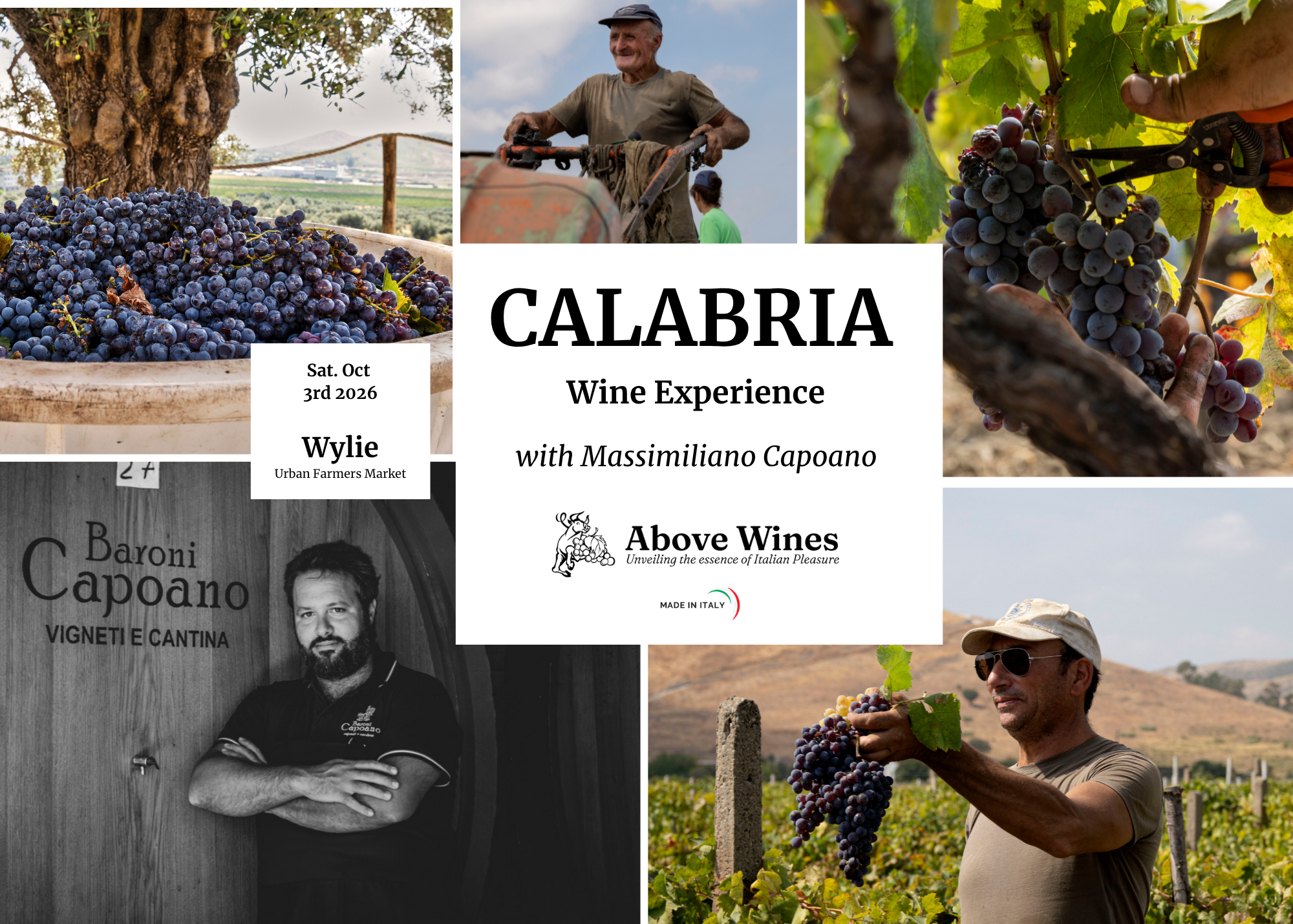
Discover the wines of Calabria, one of Italy’s most fascinating and still-undiscovered wine regions, during an intimate evening hosted byAbove Wines.
For this special experience, we are welcomingthe owner of Baroni Capoano, visiting us directly from Calabria, together with our own winemakerAldo Bove, for a live tasting focused on the wines, native grapes, traditions, and stories of Southern Italy.
This is not just a wine tasting.
It is a little trip to Calabria — right here in North Texas!
✨ YOUR TICKET INCLUDES
✔Unlimited tastings of 6+ Calabria wines
✔Unlimited return poursof your favorite wines throughout your session
✔Live guided wine tastingwith Aldo Bove and our special Calabria guest from Baroni Capoano, owner Massimiliano!
✔Italian appetizersto enjoy with the wines
✔Crystal wine glass to take home
✔Above Wines branded wine glass pouch
🍕 MAKE IT A FULL SOUTHERN ITALIAN EVENING
Starting at6:00 PM, our friends atLove, Life & Pizzawill be serving their fantastic menu outdoors at Urban Farmers Market.
After the first tasting session, guests can grab a seat outside, order their favoriteNeapolitan-style pizza, and choose a bottle of the Above Wines they enjoyed during the tasting to share at the table.
Enjoy your pizza, wine, and good company outdoors under the stars —just like a summer evening in Southern Italy.
Pizza and additional bottles of wine are available for purchase separately.
Whether you join us before your tasting, after your tasting, or simply stay for the pizza and wine, we invite you to make a full evening of it.
CLICK TO FIND OUT MORE
For all this new "ITALIAN COASTAL RESTAURANTS" opening in Dallas, try a real flavor of Italian Coastal Wines!
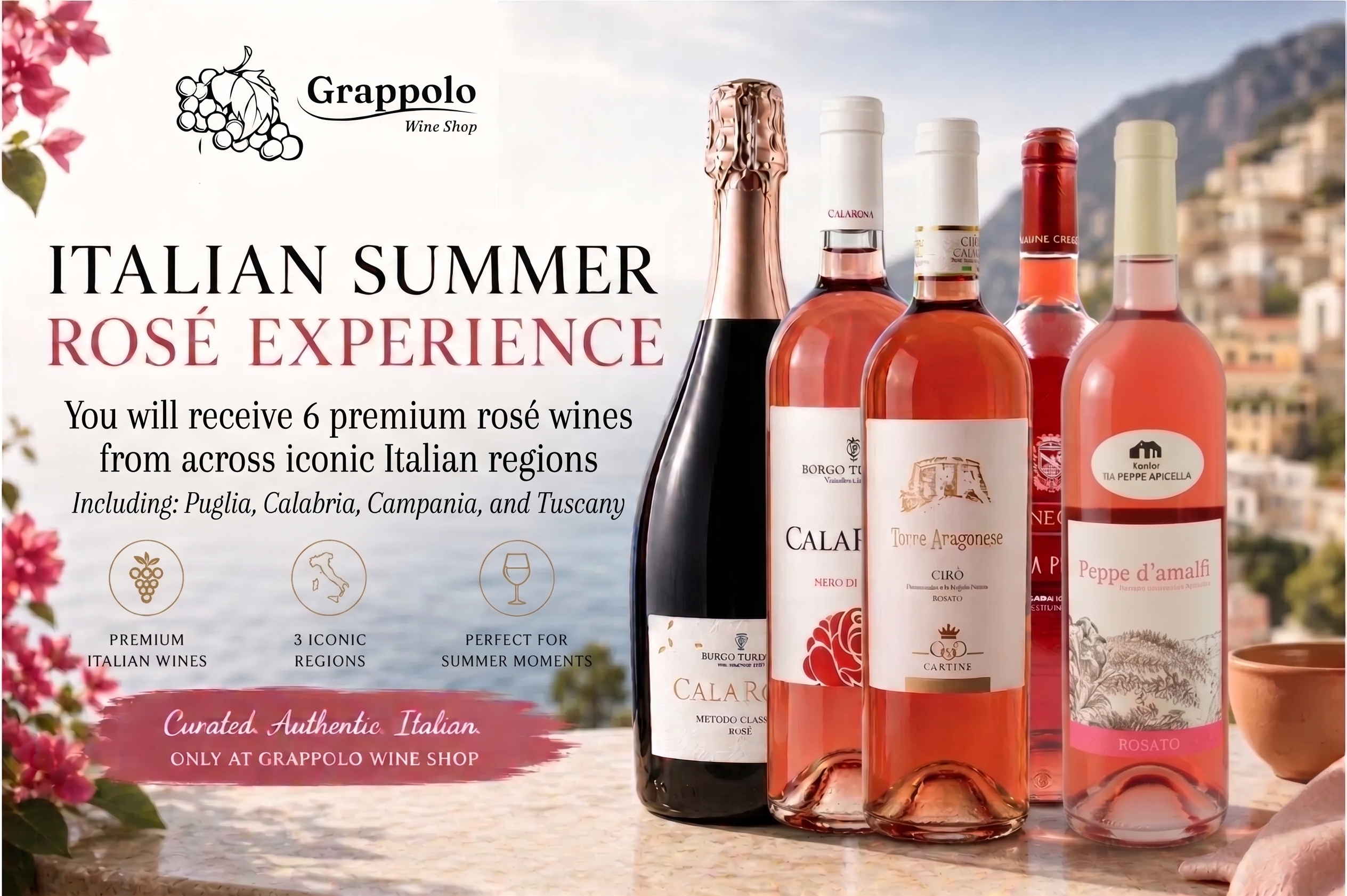
What if summer had a scent? Roses, ripe red berries, sea air, and the warmth of the Italian coast. This curated 6-bottle collection brings together rosé wines from Puglia, Calabria, and Campania, three beautiful coastal regions where sunshine, Mediterranean breezes, and native grapes create vibrant and refreshing rosati.
Among the six bottles is a rare traditional-method sparkling rosé, Italy’s elegant answer to Champagne, with fine bubbles and delicate floral notes that can remind you of fresh rose petals.
Six wines. Three coastal regions. One taste of Italian summer.
🌹 Winemaker Selected
🇮🇹 Puglia • Calabria • Campania
🥂 Includes Rare Traditional-Method Sparkling Rosé
🍷 Small-Production Wines
🚚 Fast Delivery in Texas & California
💰 Save 15–20% vs. Individual Bottles
Limited Allocation
Try the Wine, 24hr Shipping:
ITALIAN ROSE EXPERIENCE, 6 Pack
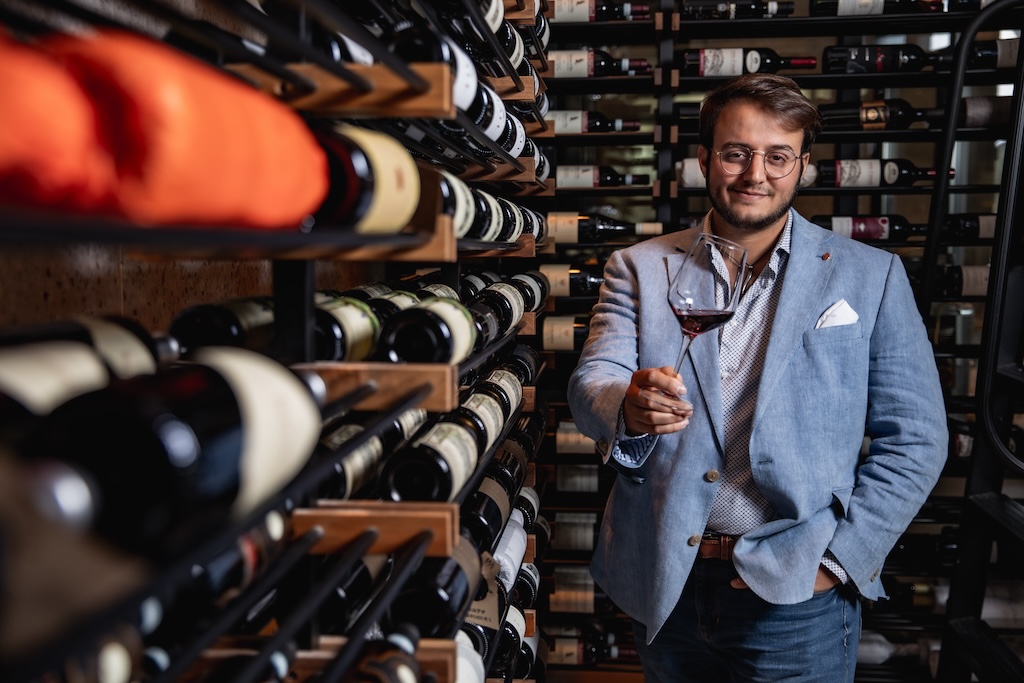
Tonight, I’ll probably open something simple. Maybe from the south.
Something that reminds me why I started doing this in the first place.